Brush Clearing Services
Overgrown Land Cleared to a Usable Condition
Brush clearing in Boston for dense understory, overgrown acreage, and rural land that needs to be brought back into use
Rural acreage in Thomas County that has not been managed for several years develops dense understory and invasive brush that makes the land impassable, reduces usable area, and creates conditions where fence lines disappear and field boundaries become impossible to maintain. CJ Properties clears that kind of overgrown rural land across the Boston area and Thomas County region, using forestry mulching equipment to process brush, understory, and smaller-diameter material directly on-site without hauling debris out in loads. The result is open, workable ground with defined boundaries rather than an overgrown parcel that needs additional passes to reach a usable condition.
The owner prices each brush clearing job on-site the same day, evaluating the density of growth, the extent of the overgrown area, and any access constraints before quoting. That direct evaluation matters because brush density varies significantly across a single parcel—what looks uniform from the road may shift dramatically inside the tree line—and a flat rate without a site visit produces either an underestimate on dense material or an overcharge on lighter growth. CJ Properties communicates before arrival on larger jobs so that both sides understand the scope before equipment is mobilized, which keeps the project efficient from the first day on-site.
Arrange an on-site visit to walk the property and get a same-day assessment of the clearing scope and equipment approach before scheduling begins.
What Forestry Mulching Produces Versus Manual Brush Removal
Forestry mulching processes brush and understory by grinding material in place during a single equipment pass, which eliminates the cut-pile-haul sequence that manual clearing requires.
The mulched material stays on-site as ground cover that breaks down naturally, which avoids debris disposal entirely and leaves the cleared surface passable immediately after the equipment moves through. For large rural parcels—where week-long clearing projects are typical for CJ Properties—that processing speed and the absence of debris staging means more ground is cleared per day and the property remains accessible throughout the job rather than being blocked by cut material waiting for removal.
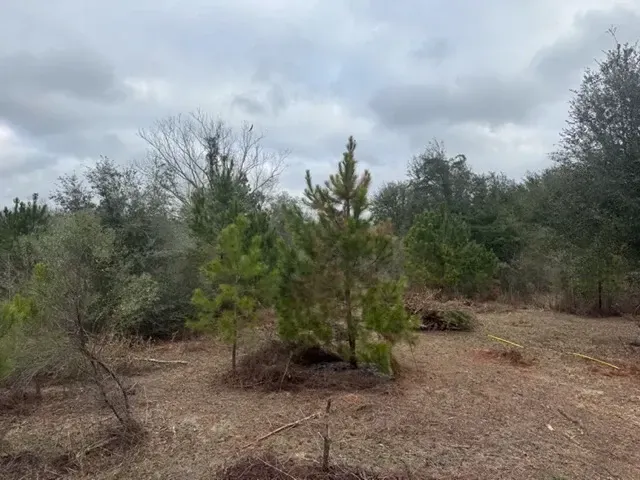
Once the mulching pass is complete across an overgrown section, fence lines become visible and repairable, field boundaries are reestablished, and areas that were inaccessible by vehicle become drivable again. Properties that had lost productive acres to advancing understory have those acres back in a condition that can be maintained with far less effort going forward. The transition from dense brush to open ground is visible and immediate after each pass, which allows the owner to evaluate progress throughout the project.
For areas where selective clearing is the goal—removing specific species or preserving canopy trees while clearing beneath—manual clearing methods are used alongside the mulching equipment. CJ Properties determines which approach applies to each section of the property during the on-site evaluation rather than defaulting to a single method across the entire job.
How does the equipment handle brush that varies in density across the same parcel?
The forestry mulcher adjusts pace based on material density—thicker sections take more passes or slower movement through the growth, while lighter brush clears quickly in a single pass. The on-site evaluation identifies where dense concentrations are located so those sections can be scheduled for adequate time rather than being rushed.
What types of brush and understory does forestry mulching handle effectively?
Forestry mulching handles brush, invasive understory, briars, small saplings, and low-canopy growth efficiently. Larger-diameter material that exceeds the equipment's processing range is addressed separately, either by chainsaw work before the mulching pass or by leaving selected trees in place during a selective clearing job.
How is a large multi-acre clearing project typically sequenced?
Access corridors and perimeter lines are usually cleared first so equipment can move through the interior and the property owner can see progress along fence lines and boundaries early in the project. Interior sections are then cleared in a systematic pass pattern that prevents equipment from working into dead ends or crossing previously mulched material unnecessarily.
What condition is the cleared ground in after the mulching equipment finishes a pass?
The ground is drivable and open, with mulched material spread evenly across the surface rather than piled. There is no debris to haul and no staging area required, so the cleared portion is immediately accessible to the property owner after the equipment moves through.
How does brush clearing on Boston-area rural properties connect to future land management?
A properly cleared parcel is significantly easier to maintain going forward because the root systems of cleared understory weaken once the above-ground material is gone and recurring growth is lighter than the initial overgrowth. Properties that are re-cleared on a periodic basis before growth re-establishes require less equipment time each cycle than parcels cleared after years of dense accumulation.
Questions Before Starting Your Brush Clearing Project
Brush clearing on rural Thomas County acreage involves decisions about equipment, method, and sequencing that depend on what is growing, how dense it is, and what the property needs to look like when the work is done. These questions address what drives those decisions on a typical clearing project.
CJ Properties also clears brush in Thomasville and across the broader Thomas County region. Call (229) 630-1331 to set up an on-site walkthrough and get a same-day assessment of what your property requires before clearing begins.
Ready to Get Started with CJ Properties?
We're here to help!
Contact Us
We will get back to you as soon as possible.
Please try again later.