Large-Acreage Clearing Services
Clearing Multi-Acre Properties Requires a Coordinated Plan
Large-Acreage Clearing Services in Boston for rural parcels requiring forestry mulching, excavation, and structured project timelines
CJ Properties handles large-acreage clearing projects starting at five acres, working across rural residential parcels, hunting land, and properties being reclaimed for active use. Owner-managed from the initial site estimate through final cleanup, every project in the Boston area is bid and scheduled by the same person overseeing the work. That structure matters on jobs where scope can shift mid-project and communication gaps become costly delays.
The clearing process at CJ Properties combines two distinct methods depending on what the site requires. Forestry mulching grinds standing trees and dense brush directly into mulch on-site, eliminating hauling costs and leaving the ground ready for its next use without the erosion risk that open burning creates. Where stumps and root systems need full removal, excavation handles the extraction so the cleared ground can support construction, food plot establishment, or other development purposes. Most projects in this region run one week to one month depending on acreage and vegetation density, and the owner contacts clients the day before work begins and again one to two hours prior to arrival each day.
Arrange an on-site estimate with CJ Properties to review the specific vegetation density, access conditions, and clearing method that fits your property.
How Forestry Mulching and Excavation Work Together on Large Sites
On a five-plus-acre clearing job, the sequencing of mulching and excavation determines how cleanly the site finishes.
Forestry mulching moves first across areas with standing timber and overgrown brush, processing material in place and reducing the overall volume the excavator needs to manage. Once the surface is cleared, excavation targets stumps and root balls that mulching equipment cannot fully address, pulling the root structure out so the cleared area compacts predictably and does not develop sinkholes or uneven settling under load.
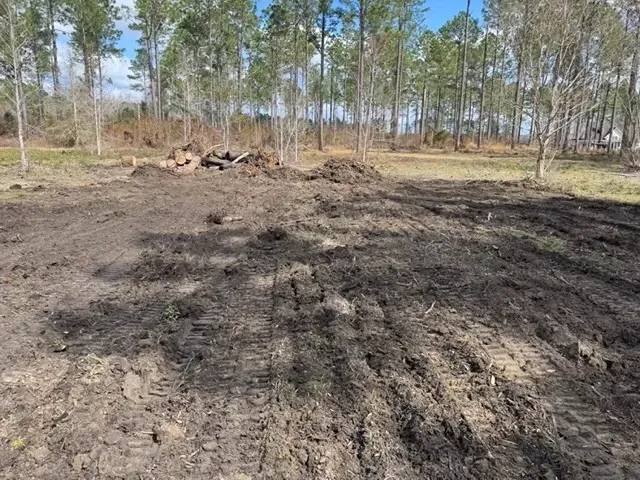
After both phases complete, what you will notice is a ground surface with consistent texture, no standing debris, and root systems fully extracted where excavation was applied. Mulched areas leave a layer of processed organic material that breaks down over time and does not require additional grading in most cases. The difference between a site that has been properly cleared and one that has only been surface-cut shows up months later when the root systems of improperly handled stumps begin to decay and create voids.
CJ Properties generated $1.4 million in clearing revenue in its first active season on the land clearing side and is tracking toward $2 million in the current year, which reflects the volume of multi-week large-acreage projects the operation is built to handle. Owner involvement in every site estimate means the bid reflects actual conditions rather than a square-footage formula applied without a site visit.
What is the difference between forestry mulching and excavation on a clearing project?
Forestry mulching uses a rotating drum attachment to grind standing trees and brush into mulch directly on-site, which is efficient for areas with dense vegetation where the goal is surface clearing. Excavation removes stumps and root balls at the soil level, which is necessary when the cleared land needs to support structures, food plots, or anything requiring a stable, root-free base.
How does the size of a property change the clearing approach?
Properties above ten acres typically require the two-phase mulching-then-excavation sequence rather than a single-pass method, because the volume of material and variation in vegetation density across the site makes a combined approach more efficient and produces a cleaner result.
What should you do to prepare a large rural property before clearing begins?
Identifying and marking any buried utilities, fence lines, or property boundary markers before the crew arrives prevents accidental removal and helps the operator work more efficiently without stopping to verify boundaries mid-job.
How does vegetation type affect how long a clearing project takes in this region?
Hardwood timber with established root systems takes significantly longer to process per acre than pine or scrub brush because the root mass is denser and excavation depth increases, which is a common condition on older rural parcels throughout Boston and the surrounding Thomas County area.
What does the cleared surface look like once forestry mulching is complete?
The mulched layer lies flat across the ground, composed of chipped wood and bark material typically two to four inches deep, and the tree line is fully removed with no standing stumps in the mulched zone, leaving a surface that is immediately accessible on foot and by equipment.
What Property Owners Ask About Large-Acreage Clearing
Multi-acre clearing projects in the Thomas County area involve a range of decisions that depend on vegetation type, intended use, and access conditions. These answers address the most common questions about how the work itself is performed.
CJ Properties also performs large-acreage clearing in Thomasville, Valdosta, Tallahassee, and surrounding communities across the seven-county service region. To discuss your property's specific clearing requirements and get a site-based estimate, contact CJ Properties directly at (229) 630-1331.
Ready to Get Started with CJ Properties?
We're here to help!
Contact Us
We will get back to you as soon as possible.
Please try again later.