Storm Debris and Hurricane Cleanup Services
Storm Damage Cleanup That Starts Before the Roads Clear
Storm Debris and Hurricane Cleanup Services in Boston for fallen timber, root ball extraction, and post-hurricane property access restoration
A major storm can drop enough timber on a rural property to make it functionally inaccessible within hours. CJ Properties responds to storm debris and hurricane cleanup calls across Southern Georgia and North Florida, deploying forestry mulching and excavation equipment to process fallen trees, extract root balls, and restore access to properties that have been blocked or damaged by severe weather events. The owner coordinates directly with property owners on access, timing, and sequencing before any crew arrives on-site.
The cleanup process depends on what the storm left behind. Forestry mulching processes fallen timber and scattered brush directly on-site, converting downed trees into mulch without requiring the material to be hauled out, which matters enormously on rural parcels where road access may already be compromised. Where root balls have been pulled from the ground by uprooted trees, excavation removes the root mass and fills the void left behind. CJ Properties uses Google Calendar-based scheduling reminders and pre-arrival calls to coordinate with property owners, which is especially important after a storm when access routes and site conditions can change between the estimate and the work date.
To assess the scope of storm damage on your property and schedule cleanup, call CJ Properties at (229) 630-1331 for a direct conversation with the owner.
Why Storm Debris Removal Differs From Standard Clearing Work
Standard land clearing removes standing vegetation in a planned sequence.
Storm cleanup starts with material that has already fallen in unpredictable patterns, often across each other, with root systems exposed and destabilized soil underneath. The operational difference is significant: operators must assess each downed tree individually before processing it, because an improperly approached root ball on soft post-storm ground can shift under equipment weight. Diesel fuel availability is a logistical factor on multi-week storm jobs in rural areas, and CJ Properties accounts for that in project planning to avoid mid-job delays on remote parcels.
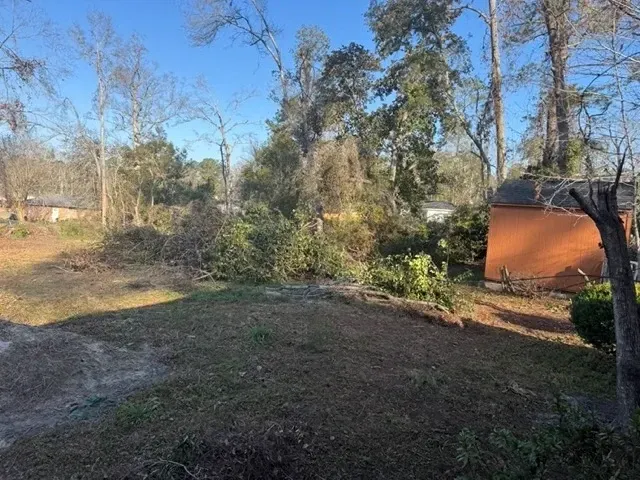
Once the debris is processed and root balls are extracted, you will notice the immediate change in navigability. Drive lanes that were blocked by fallen timber become passable, structures that were obscured by downed canopy become accessible for inspection, and the ground no longer has the open voids and exposed root mass that create ongoing hazards for people and equipment moving across the property. The mulched output from processed timber lies flat and does not require secondary hauling, which accelerates the restoration timeline compared to cut-and-stack cleanup methods.
Post-hurricane work in this corridor also involves coordination with property owners who may still be off-site during evacuation. CJ Properties maintains direct owner communication throughout the job, with check-in calls placed the day before each work session and again one to two hours before arrival, so property owners who are managing cleanup remotely stay informed about what has been completed and what comes next.
How is fallen timber processed differently than standing trees during storm cleanup?
Fallen timber has to be assessed for how it landed and what is underneath before the mulching drum makes contact, because downed trees often rest on other debris or on destabilized soil that behaves unpredictably under equipment weight, requiring the operator to sequence cuts and processing from the outside of a pile inward.
What happens to the root ball when a tree is uprooted by a storm?
The exposed root ball is excavated from the surrounding soil, the void beneath is backfilled to prevent ongoing ground collapse, and the root mass is either processed on-site or removed depending on its size and the intended use of the cleared area.
How do you prepare your property for a cleanup crew after a hurricane?
Identifying the safest access point for heavy equipment and flagging any buried utilities or underground structures near the downed trees helps the crew move efficiently without stopping to investigate potential hazards mid-job.
Why does on-site processing matter more after a storm than in standard clearing work?
After a storm, road access to rural parcels in the Thomas County area is frequently compromised by debris on public roads and private drives, making on-site mulching critical because it eliminates the need to haul large volumes of material out over roads that may not support loaded trucks.
What quality indicators show that a storm cleanup job has been finished correctly?
A properly finished storm cleanup site has no remaining root voids in the ground, no standing debris or unsecured timber, mulched areas lying flat without loose trunk sections, and all access routes clear of material at a width sufficient for the property owner's equipment to pass through.
Answers About How Storm Cleanup Work Is Done
Post-storm cleanup on rural and hunting properties in the Boston area involves decisions that differ from routine clearing jobs. These questions address how the work is actually performed after significant wind and debris events.
CJ Properties also handles storm debris and hurricane cleanup in Thomasville, Valdosta, Tallahassee, and communities throughout the seven-county service region. Speak directly with the owner about your property's post-storm conditions by calling (229) 630-1331.
Ready to Get Started with CJ Properties?
We're here to help!
Contact Us
We will get back to you as soon as possible.
Please try again later.