Tree Removal Services
Trees Down and Material Managed in One Operation
Tree removal services in Boston for storm-damaged timber, rural acreage clearing, and overgrown property access
A downed or storm-damaged tree on rural acreage isn't a standalone problem—it's part of a broader site condition that usually involves multiple trees, tangled debris, and access that's been cut off by the fallen material. CJ Properties handles tree removal as part of its integrated land clearing and storm cleanup operations across Thomas County, which means removed timber is processed on site using forestry mulching equipment rather than left in piles for a follow-up crew to deal with. That integration is the operational difference between a removal job that leaves the property cleared and one that leaves it partially cleared.
CJ Properties maintains an active storm cleanup operation with dedicated budget for hurricane-season emergency work. When storm-damaged timber needs to come down across rural properties, the equipment already deployed for land clearing handles the removal and material processing in the same mobilization. Removed trees are fed through the mulching drum or processed with excavation equipment depending on root mass and debris configuration, leaving the cleared area in a condition that doesn't require additional haul-out.
Contact CJ Properties to schedule a site visit for tree removal assessment and same-day project pricing.
How Tree Removal Integrates with Larger Clearing Work
Tree removal that's handled as a standalone service—cut, drop, chip the brush, leave the stump—addresses the immediate hazard but doesn't resolve what the root system leaves behind or what the removed canopy was part of. On rural acreage where the goal is cleared, accessible ground, the stump and root mass are part of the scope. CJ Properties treats tree removal as a phase of the land clearing workflow, not a separate trade, which means the equipment on site has the capability to address what's below ground level as well as what came down above it.
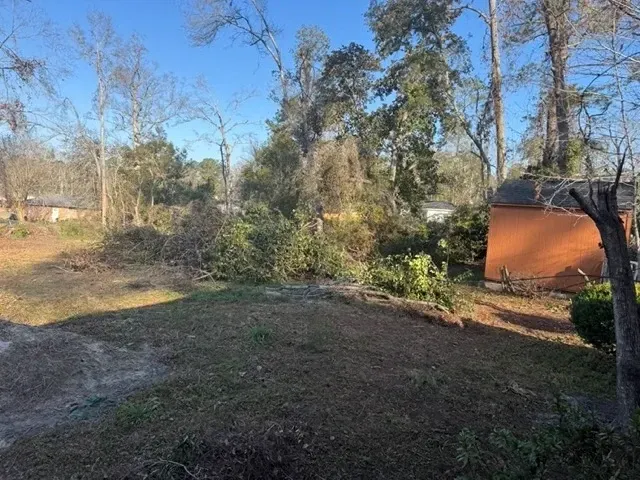
After tree removal and material processing are complete, the visible change is unobstructed ground where the tree or debris field stood. On properties where storm-damaged trees blocked road access, equipment staging areas, or agricultural operations, that clearance is the functional outcome—access restored, debris processed, surface ready for the next phase. CJ Properties sequences removal work so that material doesn't have to be moved twice before it's gone from the operational area.
Rural properties in the northern Florida corridor adjacent to Thomas County face hurricane-season timber damage that creates urgent removal needs across large acreage simultaneously. CJ Properties' operational scale—week-long project capacity, equipment already deployed regionally—positions the company to handle that volume of removal work without the scheduling constraints that smaller single-crew operations encounter during high-demand periods.
How does forestry mulching equipment handle removed timber?
\Trees processed by the mulching drum are shredded in place, converting the removed material into ground-level mulch rather than debris that has to be staged and hauled. That approach is most efficient on acreage where multiple trees are being removed across a continuous clearing area.
What happens to the root system after a tree is removed?
Root mass below grade requires excavation equipment to extract if the site will be graded, built on, or used for agriculture. When the removal is part of a larger site preparation scope, CJ Properties addresses root systems as part of that integrated workflow rather than a separate return visit.
How is storm-damaged tree removal sequenced differently than routine removal?
Storm debris creates irregular distribution across the property—leaning trees, hanging limbs, and tangled crowns that change how equipment can approach safely. The removal sequence is determined by hazard level and access priority rather than the standard clearing sweep used on standing timber.
What condition is the removal site in when the work is finished?
Removed trees are either processed to mulch on site or excavated with root mass intact depending on scope. The cleared area is left at a condition consistent with the next phase of work—grading, planting, or road access restoration.
When does tree removal require excavation in addition to cutting?
Any situation where the stump and root mass would interfere with the intended surface use—a building pad, a field road, a drainage swale—requires excavation to remove what the cut itself doesn't address. That determination is made during the site walkthrough before pricing is given.
What to Know Before Tree Removal Begins
Tree removal on rural acreage in Thomas County involves conditions—root mass depth, debris volume, access, and end-use requirements—that affect both how the work is sequenced and what equipment is appropriate for each situation.
CJ Properties also performs tree removal services in Thomasville, Quitman, Moultrie, Valdosta, Tallahassee, and throughout the seven-county region. To discuss your property's tree removal needs and get a same-day assessment, call CJ Properties at (229) 630-1331.
Ready to Get Started with CJ Properties?
We're here to help!
Contact Us
We will get back to you as soon as possible.
Please try again later.